Criminal Defense, DUI, Formal Review Hearing, Legal Blog

Florida DUI – Formal Review Hearings

When a person is arrested for Driving Under the Influence (DUI) in Florida, the Department of Highway Safety and Motor Vehicles automatically and immediately suspends that person’s driver’s license. The officer will issue the driver a Temporary Driving Permit, which is only valid for 10 days from the date of the arrest. Thereafter, the person’s license will be suspended, unless granted an extension on the temporary permit for the purposes of attending a Formal Review Hearing or unless the suspension is overturned during a Formal Review Hearing (which is discussed more in depth below.) This “DMV License Suspension” is a civil suspension and is separate from a criminal charge, which may also include its own suspension.

For a first DUI, the DMV license suspension will be 6 months. For a second or subsequent DUI, the DMV suspension will be 1 year. Additionally, a first refusal to submit to a Breath Test (see Breathalyzers) will lead to a 1 year DMV issued license suspension, and a second or subsequent refusal will lead to an 18 month DMV issued license suspension.

Florida Statutes 322.2615 and 322.64 provide the opportunity for a person to challenge a DMV’s license suspension by way of a “formal review hearing” (FRH). The purpose of a Formal Review Hearing is for a hearing officer, who works for the DMV, to make a determination as to whether the person’s civil license suspension should be sustained, amended or invalidated based upon the evidence presented. A person must request a FRH within 10 days of being arrested, or lose the opportunity for the hearing. If a review hearing is requested, the DMV must schedule the hearing within 30 days of the request. 

Interestingly, the decisions made during the Formal Review Hearing are not admissible as evidence in court on the criminal DUI action. And, the outcome of the Formal Review Hearing has no bearing on the outcome of the criminal suspension. In other words, a hearing officer during a Formal Review Hearing could invalidate a license suspension and a person could have a valid license while fighting his or her DUI charge in criminal court. If at the end of the criminal case, the judge or jury find the defendant guilty, or if the defendant pleads guilty, the defendant’s driver’s license will be suspended in the criminal case. For a description of the criminal penalties associated with DUI on a first arrest, see DUI Penalties.

During the Formal Review Hearing, the hearing officer will determine 1) Whether the police officer had probable cause to believe that the driver was driving or in actual physical control of a motor vehicle in this state while under the influence of alcoholic beverages or chemical or controlled substances and 2) Whether the driver had an unlawful blood-alcohol level or breath-alcohol level of .08 or higher. The hearing officer will determine this by a “preponderance of the evidence,” meaning that if the hearing officer finds it is more likely than not that the driver was under the influence or had a BAC of .08 or higher, the driver’s license suspension will stay in effect.

The police officer will typically testify during the hearing, and the police report will usually be introduced into evidence. All of which the driver is entitled to see. Formal Review Hearings give the driver an opportunity to not only fight the civil license suspension, but also to obtain testimony from the police officers involved in the arrest.

Many times Formal Review Hearings result in the license suspension being sustained. Even in those cases, people often find that they learned valuable information from the police officer’s testimony that they may not have been able to obtain during the criminal case (until the day of trial). That is especially true in Palm Beach County, where depositions of police officers in misdemeanor cases (which DUIs typically are charged as) are not usually permitted. 

Anyone who has been arrested for Driving Under the Influence (DUI) in Palm Beach County should contact a Palm Beach Criminal Defense Lawyer to discuss their options and decide if a formal review hearing should be requested, as time is of the essence. 


Casey Reiter is an associate attorney at Stuart R. Manoff & Associates, P.A. in West Palm Beach, Florida, practicing in the areas of Criminal Defense and Marital Law.

Criminal Defense, InfoFriday, Legal Blog

Miranda Warnings – Infographic

We see police officers give Miranda Warnings to people they are arresting on television all the time, but what are they really?

Miranda Rights were developed after the landmark Supreme Court Case of Miranda v. Arizona in 1966. In that case, the defendant, Miranda, was arrested for kidnapping and rape. After being interrogated for two hours by police officers without being advised of his rights, Miranda signed a confession. Miranda’s lawyer argued that the confession was not voluntary as a result, and should have been excluded as evidence from the trial. The US Supreme Court ultimately agreed, and found that the defendant’s Fifth Amendment right against self-incrimination and Sixth Amendment right to a lawyer had been violated. Interestingly, Miranda was later retried and convicted.

In its ruling, the US Supreme Court stated that prior to interrogation, a person who is in custody must be clearly informed that he/she has (1) the right to remain silent, (2) that anything he/she says can and will be used against him/her in a court of law, (3) that he/she has the right to consult with an attorney prior to and during any questioning, and (4) that if he/she cannot afford an attorney, one will be provided for him/her at no cost. 

Subsequent to the Miranda decision, it became necessary for police officers to “Mirandize,” or read a person’s Miranda Rights to them, prior to an interrogation. Although we commonly see police officers reading Miranda Rights on tv, it is not always necessary for them to do so. There are only certain, limited scenarios in which an officer has to warn a person of his/her rights, specifically: when that person is in custody and being interrogated. Many people believe that their criminal charges can be “thrown out” because an officer didn’t read Miranda. However, if a person voluntarily answered questions during a consensual encounter with police officers (for example, an officer walked up to the person on the street and asked them what they were doing), those answers can be used against them later. A person who is arrested, handcuffed and taken to jail does not have to have their rights read to them unless the officer begins asking that person questions. If the arrested person starts talking on his/her own in the back of the police car, without being asked questions, all of those statements can be used against the arrestee. Further, suspects who are informed they are free to leave and not under arrest do not have to be Mirandized, and any confession that person gives can usually be used in court. Finally, even if a person has been read Miranda Rights, that person can still waive those rights and have any subsequent confession used against them.

A person who IS placed under arrest and interrogated without being read Miranda Rights may be able to have his/her statements suppressed (or thrown out). However, that does not mean the case has to be or will be dismissed. Anyone who has questions regarding their particular case, or Miranda rights in general, should contact a criminal defense attorney.

The infographic below provides a colorful layout of Miranda Rights as they are typically read.

Miranda Warnings


Casey Reiter is an associate attorney at Stuart R. Manoff & Associates, P.A. in West Palm Beach, Florida, practicing in the areas of Criminal Defense and Marital Law.

Appeal, Criminal Defense, Legal Blog, Solicitation

Constitutionality of Solicitation Fines in Florida

A county court in Florida recently certified an important issue to the Second District Court of Appeal regarding excessive fines as a punishment for solicitation of prostitution.

In the case, the defendant was charged by Information with Solicitation of Prostitution, under Florida Statute 796.07(2). Solicitation for Prostitution is a second degree misdemeanor in the State of Florida, and second degree misdemeanors are punishable by up to 60 days in county jail, and a fine of up to $500, except where a specific statute allows for a higher fine. In the case of solicitation for prostitution, as of January 1, 2013, the fine is mandated by statute to be $5,000 instead of $500 for a first offense. The Defendant filed a “Motion to Find Statute Unconstitutional,” arguing that the fine was grossly disproportion to the offense, and therefore excessive under (1) the Eighth Amendment to the United States Constitution, which provides that: “Excessive bail shall not be required, nor excessive fines imposed, nor cruel and unusual punishments inflicted” and (2) under Article I, Section 17 of the Florida Constitution, which provides that: “Excessive fines, cruel and unusual punishment, attainder, forfeiture of estate, indefinite imprisonment, and unreasonable detention of witnesses are forbidden.”

The court initially reserved jurisdiction on deciding the defendant’s motion. The defendant then entered a plea of nolo contendere (or “no contest”) and was sentenced to, among other things, six months of probation, twenty-five hours of community service, and a $5,000 fine. After sentencing the defendant, the court ruled on the defendant’s “Motion to Find Statute Unconstitutional.”

The court ultimately agreed with the defendant, granted the defendant’s motion, and struck the $5,000 fine, finding that a fine may be considered unconstitutional if it is so unreasonably excessive that it shocks the conscience of a reasonable person. The court then certified the question to the Second District Court of Appeal as a matter of great public importance, asking the Appellate Court to decide if a $5,000 fine for a first violation of solicitation of prostitution is unconstitutionally excessive. It will be interesting to see if and how the 2nd DCA rules on this question.


Casey Reiter is an associate attorney at Stuart R. Manoff & Associates, P.A. in West Palm Beach, Florida, practicing in the areas of Criminal Defense and Marital Law.

Criminal Defense, InfoFriday, Legal Blog

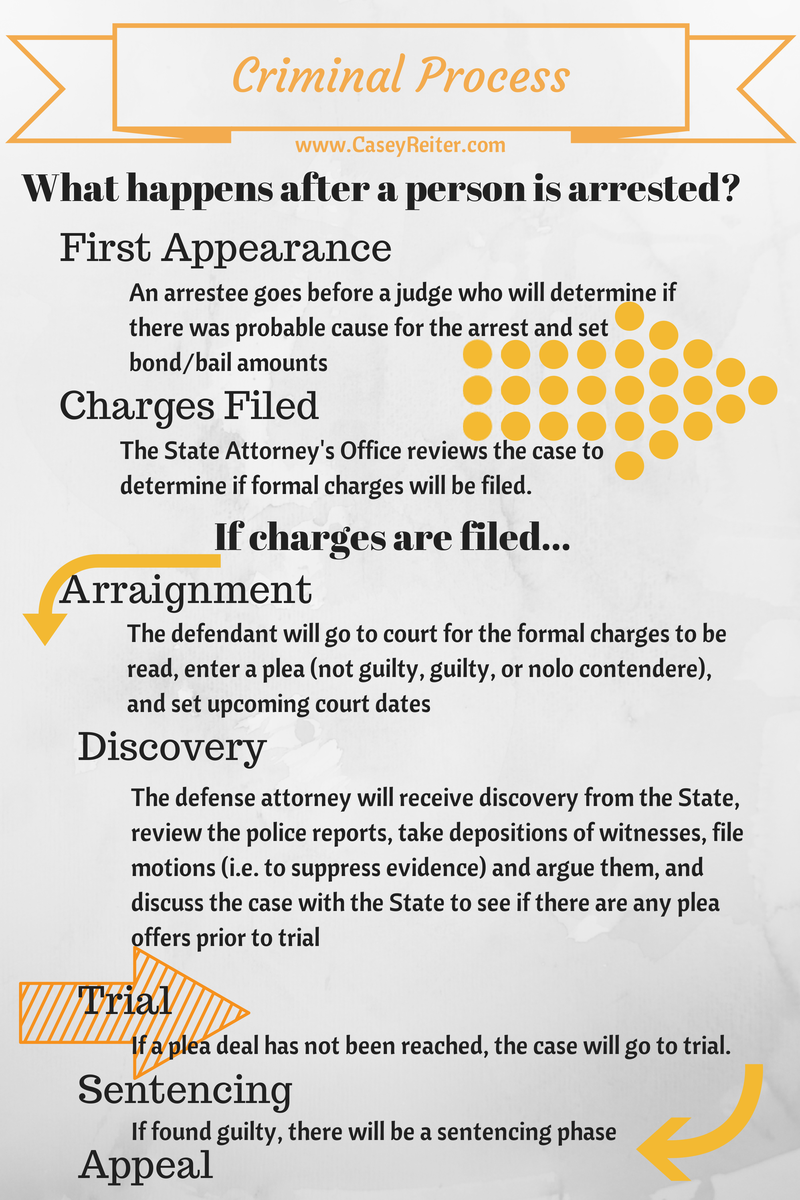
Criminal Process in Florida – Infographic

Anyone wondering the basics of the criminal process in Florida might find this infographic helpful!

50 (1)


While the graphic above explains the basics of the Florida Criminal Process, anyone who is arrested and facing charges should contact a Florida Criminal Defense Attorney  who can review the particular case and provide a detailed explanation of the specific process relating to that case.


Casey Reiter is an associate attorney at Stuart R. Manoff & Associates, P.A. in West Palm Beach, Florida, practicing in the areas of Criminal Defense and Marital Law.