Appeal, Breathalyzer, Criminal Defense, DUI, Legal Blog, License Suspension

DUI Permanent License Revocation

A Broward DUI case (Calabrese v. State) was published this week wherein a permanent license revocation was affirmed by the Broward Circuit Court.

In the case, the defendant was arrested for DUI after she drove through an area that had been roped off by police for an unrelated criminal investigation. The defendant declined to perform field sobriety exercises, but agreed to submit to a breath test and blew a .089. The defendant was found guilty by a jury at trial. The court found that this was the defendant’s third DUI within 10 years. As a result, she was ultimately sentenced to 364 days in Broward County Jail, which was to be lowered to 180 days upon completion of the SAP program (the Substance Abuse and Life Skills Program which provides treatment services to inmates in Broward County’s Jail), along with other standard DUI penalties (such as community service, fines, etc.) and a lifetime driver’s license revocation. 

The defendant appealed the lifetime driver’s license revocation, arguing that it was improper for the court to order because Florida Statute 322.28(2)(a) only requires a 10 year minimum license suspension for a third DUI conviction within 10 years. However, the circuit court disagreed and found that because there was no maximum sentence limit within the statute, the trial judge was within his discretion to issue a lifetime driver’s license revocation.

DUIs in Florida have serious consequences, as seen in this case. Anyone who is facing DUI charges in Florida should contact a criminal defense lawyer to discuss the possible penalties of a DUI conviction and determine the best defense route to attempt to mitigate those penalties. 


Casey Reiter is an associate attorney at Stuart R. Manoff & Associates, P.A. in West Palm Beach, Florida, practicing in the areas of Criminal Defense and Marital Law.

Criminal Defense, DUI, Formal Review Hearing, Legal Blog

Florida DUI – Formal Review Hearings

When a person is arrested for Driving Under the Influence (DUI) in Florida, the Department of Highway Safety and Motor Vehicles automatically and immediately suspends that person’s driver’s license. The officer will issue the driver a Temporary Driving Permit, which is only valid for 10 days from the date of the arrest. Thereafter, the person’s license will be suspended, unless granted an extension on the temporary permit for the purposes of attending a Formal Review Hearing or unless the suspension is overturned during a Formal Review Hearing (which is discussed more in depth below.) This “DMV License Suspension” is a civil suspension and is separate from a criminal charge, which may also include its own suspension.

For a first DUI, the DMV license suspension will be 6 months. For a second or subsequent DUI, the DMV suspension will be 1 year. Additionally, a first refusal to submit to a Breath Test (see Breathalyzers) will lead to a 1 year DMV issued license suspension, and a second or subsequent refusal will lead to an 18 month DMV issued license suspension.

Florida Statutes 322.2615 and 322.64 provide the opportunity for a person to challenge a DMV’s license suspension by way of a “formal review hearing” (FRH). The purpose of a Formal Review Hearing is for a hearing officer, who works for the DMV, to make a determination as to whether the person’s civil license suspension should be sustained, amended or invalidated based upon the evidence presented. A person must request a FRH within 10 days of being arrested, or lose the opportunity for the hearing. If a review hearing is requested, the DMV must schedule the hearing within 30 days of the request. 

Interestingly, the decisions made during the Formal Review Hearing are not admissible as evidence in court on the criminal DUI action. And, the outcome of the Formal Review Hearing has no bearing on the outcome of the criminal suspension. In other words, a hearing officer during a Formal Review Hearing could invalidate a license suspension and a person could have a valid license while fighting his or her DUI charge in criminal court. If at the end of the criminal case, the judge or jury find the defendant guilty, or if the defendant pleads guilty, the defendant’s driver’s license will be suspended in the criminal case. For a description of the criminal penalties associated with DUI on a first arrest, see DUI Penalties.

During the Formal Review Hearing, the hearing officer will determine 1) Whether the police officer had probable cause to believe that the driver was driving or in actual physical control of a motor vehicle in this state while under the influence of alcoholic beverages or chemical or controlled substances and 2) Whether the driver had an unlawful blood-alcohol level or breath-alcohol level of .08 or higher. The hearing officer will determine this by a “preponderance of the evidence,” meaning that if the hearing officer finds it is more likely than not that the driver was under the influence or had a BAC of .08 or higher, the driver’s license suspension will stay in effect.

The police officer will typically testify during the hearing, and the police report will usually be introduced into evidence. All of which the driver is entitled to see. Formal Review Hearings give the driver an opportunity to not only fight the civil license suspension, but also to obtain testimony from the police officers involved in the arrest.

Many times Formal Review Hearings result in the license suspension being sustained. Even in those cases, people often find that they learned valuable information from the police officer’s testimony that they may not have been able to obtain during the criminal case (until the day of trial). That is especially true in Palm Beach County, where depositions of police officers in misdemeanor cases (which DUIs typically are charged as) are not usually permitted. 

Anyone who has been arrested for Driving Under the Influence (DUI) in Palm Beach County should contact a Palm Beach Criminal Defense Lawyer to discuss their options and decide if a formal review hearing should be requested, as time is of the essence. 


Casey Reiter is an associate attorney at Stuart R. Manoff & Associates, P.A. in West Palm Beach, Florida, practicing in the areas of Criminal Defense and Marital Law.

Criminal Defense, DUI, Legal Blog

Breathalyzers

When a person is arrested for driving under the influence (DUI) in Palm Beach County, Florida, a police officer will request that person submit to a breath alcohol test in most scenarios. While a person may refuse to take a breath test, Florida’s implied consent laws provide that refusal to submit to a breath test can result in a 1 year drivers license suspension, or more, and the refusal to provide a breath sample can be used in a DUI trial as evidence of guilt.

A person who is arrested for DUI in Palm Beach County will typically take a breath test at the BAT (or Breath Alcohol Testing Facility) located at the “Gun Club” Main Detention Center. Prior to administering the test, an officer will wait 20 minutes and observe the arrestee to ensure that the person does not put anything into his or her mouth, regurgitate, vomit, or belch, as these actions can influence the test result. Once the 20 minute “observation period” is over, the officer will ask the arrestee to blow into the machine (Palm Beach Sheriff’s Office currently uses the Intoxilyzer 8000) for a certain length of time and then tell the person to stop. If the test-taker does not blow hard enough into the machine, or does not provide enough air, the machine could read an error, requiring an additional attempt. If an officer believes that the person is purposefully not providing enough air in an attempt to trick the Breath Test, the officer could count that as a refusal and end the test.

A breathalyzer measures the amount of alcohol in a person’s breath, and converts that into a Breath Alcohol Level, or BAL, also referred to as a Breath Alcohol Content (BAC). A .08% BAL/BAC is equal to .08 grams of alcohol per 210 liters of breath.

Pursuant to Florida Statute 316.1934, there is a presumption in the State of Florida that a person who has a breath or blood alcohol content of .08 or above is under the influence of alcohol to the extent his or her normal faculties were impaired. There is no presumption one way or the other for a person whose BAC is between .05 and .08. When a person has a BAC of .05 or less, it is presumed that the person was not under the influence of alcoholic beverages to the extent that his or her normal faculties were impaired. 

DUI cases with breath test results are commonly prosecuted in Palm Beach because they provide scientific evidence to present to a jury of the driver’s level of impairment. However, breathalyzers can be inaccurate and have been challenged by Criminal Defense Attorneys throughout the State of Florida, including Palm Beach County. There are several things that could affect the reliability of the test results, including but not limited to: improper machine calibration, irregular temperature outside of the machine, irregular temperature of the test-taker’s body, if the test-taker is diabetic, if the test-taker holds his or her breath, chewing gum, vomiting, regurgitation, burping, acid reflux, use of mouth wash, inhalers, alcohol held in a persons mouth by dentures, or even cold sores.

A Palm Beach Criminal Defense attorney can also review data regarding a specific breathalyzer machine from FDLE (Florida Department of Law Enforcement) to examine the history of the machine’s diagnostic reports and look for past problems with the machine and the history of maintenance. FDLE has strict protocol for the testing and maintenance of Florida’s breath testing machines and provides the information to the public.

Anyone who is facing DUI charges where breathalyzers are involved in Palm Beach County should consult with a Palm Beach Criminal Defense Attorney to discuss their options. There may be defenses to the charges, methods of challenging the reliability of the breath results, or available diversionary programs.
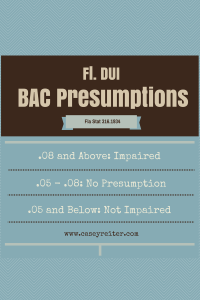
Florida DUI BAC Presumptions


Casey Reiter is an associate attorney at Stuart R. Manoff & Associates, P.A. in West Palm Beach, Florida, practicing in the areas of Criminal Defense and Marital Law.