Criminal Defense, Legal Blog, Recent News, Search and Seizure, Warrant

Police Radars Can “See” into Homes

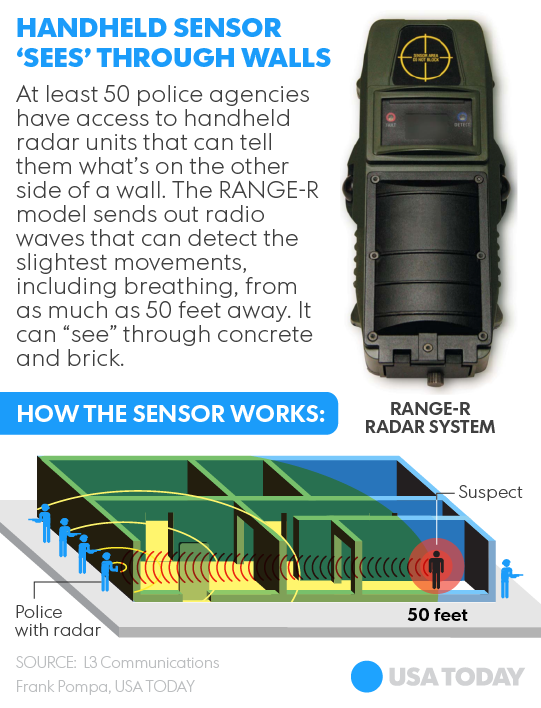
USA Today reports that new police radars can be used to, in effect, “see” through walls and into a person’s home by using radio waves to reveal human motion within a home. According to the story,

“At least 50 U.S. law enforcement agencies have secretly equipped their officers with radar devices that allow them to effectively peer through the walls of houses to see whether anyone is inside, a practice raising new concerns about the extent of government surveillance. . . .

They can detect whether anyone is inside of a house, where they are and whether they are moving.”

The law enforcement agencies have reportedly been using this technology for the past two years, without notice to the public or courts:

“Agents’ use of the radars was largely unknown until December, when a federal appeals court in Denver said officers had used one before they entered a house to arrest a man wanted for violating his parole. The judges expressed alarm that agents had used the new technology without a search warrant, warning that “the government’s warrantless use of such a powerful tool to search inside homes poses grave Fourth Amendment questions.””

An infographic by USA Today demonstrates how the radar works:
JX425CX

However, other versions of the radar reportedly have significantly more enhanced capabilities, such as “three-dimensional displays of where people are located inside a building” and “[o]ne is capable of being mounted on a drone.” This type of radar technology was initially designed as battlefield technology for use in Iran and Afghanistan. In fact, the Justice Department has reportedly funded research to continue the development of systems that can “map the interiors of buildings and locate the people within them.”

This technology, which is not now new in light of recent reports, poses significant Constitutional issues. Police are not permitted to scan the inside of a home with a thermal camera without a warrant, and drug dog sniffs of the outside of homes have been limited by the Supreme Court. While it would seem that these radars would(or should) fall under the same Constitutional analysis, it appears that the Denver federal appeals court’s decision published last month (referenced above) was the first court decision referencing the radar technology or its Constitutional implications.

The full USA Today story can be found HERE.

Casey Reiter is an associate attorney at Stuart R. Manoff & Associates, P.A. in West Palm Beach, Florida, practicing in the areas of Criminal Defense and Family law.

Criminal Defense, Legal Blog, Recent News, Theft

Fort Lauderdale Bike Registration Laws

This article provides interesting insight on tickets in Fort Lauderdale stemming from bike registration laws: Fort Lauderdale Cops Are Still Arresting Dozens for Biking While Black

The article discusses that in 2003, the City of Fort Lauderdale passed an ordinance requiring residents to register their bicycles with the city for the charge of 1$ in an effort to reduce bicycle thefts (the fee was later dropped altogether):

“City commissioners said it worked, and bike thefts decreased. Police also found that stopping bikers to check whether their bikes were registered turned out to be an effective way of finding drug dealers and house burglars. It gave cops probable cause to stop people, check their identification, and check for outstanding arrest warrants.”

However, the data seems to suggest that the police may have used the ordinance as a pretext for stopping people in “primarily African-American neighborhoods”:

According to data provided by the [Broward] Public Defender’s Office, between December 2013 and September 2014, the Fort Lauderdale PD issued only 45 tickets for unregistered bikes. Yet 42 of the violators were black — 93 percent of the total. Only one ticket was issued east of Federal Highway.

The full article can be found here:  Fort Lauderdale Cops Are Still Arresting Dozens for Biking While Black

Casey Reiter is an associate attorney at Stuart R. Manoff & Associates, P.A. in West Palm Beach, Florida, practicing in the areas of Criminal Defense and Family law.

Criminal Defense, Legal Blog, Recent News

Supreme Court: Cops don’t have to know the law

This week, the Supreme Court of the United States issued an opinion that basically confirms police officers do not have to know the law. Yes, you read that right.

In HEIEN v. NORTH CAROLINA, the driver was pulled over in North Carolina for having a busted tail light. The officer “mistakenly” believed that the law requires two working brake lights. However, in North Carolina, the law does NOT require a driver to have two working brake lights. After the officer pulled the vehicle over (even though there was NO traffic infraction to give the officer the authority to stop the car), he noticed that the driver and passenger seemed “very stiff and nervous” (as if that were bizarre behavior for a person who is being stopped by the police for no reason?). The officer then asked the driver and passenger (Heien) for permission to search the vehicle, which ultimately revealed a sandwich bag filled with cocaine.

The US Supreme Court ruled that because the officer’s mistake of law was reasonable, there was “reasonable suspicion” justifying the stop under the Fourth Amendment.

In justifying the decision, Chief Justice Roberts cited what he claims to be “precedent” finding that a reasonable mistake of fact, such as an officer who stops a motorist for driving in a high-occupancy lane only to discover two children sleeping in the back seat, can justify a search or seizure and not violate the Fourth Amendment. Roberts then goes on to conclude that a “mistake of law” is as justifiable as a “mistake of fact,” and that there was essentially no violation of anyone’s rights in either scenario.

How can that be? And what is next? It seems that this decision is setting terrible precedent that will allow officers to do whatever they want and claim later that they “didn’t know they couldn’t do that.” Arrest first, ask questions later? Forget about the far-reaching effects; let’s talk about the immediate issue: if a traffic cop’s daily job function is to stop drivers for traffic offenses (such as speeding, broken tail lights, running stop signs, etc.), shouldn’t the traffic cop be required to actually know the laws entailed? Or are we now just handing out patrol cars and badges to everyone and waiting to see what happens?

A local law student, Ana Roditi, hit the nail on the head when interviewed about the case when she stated “It’s crazy to think that ignorance of the law is no excuse, unless you’re a cop – then it’s a reasonable excuse!”

Defendants cannot claim ignorance of the law as a defense to a criminal charge. But apparently, police officers can use it as an excuse to arrest anyone they feel like.

It’s an unfortunate day for civilian rights – instead of holding law enforcement to a higher standard of actually knowing the laws they are trying to enforce, the Supreme Court is now putting the burden on civilians.

The full opinion can be found here.

Casey Reiter is an associate attorney at Stuart R. Manoff & Associates, P.A. in West Palm Beach, Florida, practicing in the areas of Criminal Defense and Family law.

Criminal Defense, Downward Departure, Legal Blog, Recent News

Downward Departure and the Right to Jury Trial

In a good case out of the 5th DCA published last week, the appellate court reiterated the constitutional right to a trial by jury.

In the case (Little v. State), the defendant elected to go to trial and was ultimately found guilty. During the sentencing phase, the trial judge made it clear that he would not even consider a downward departure argument because it was his policy that when a jury finds a defendant guilty, he will not downward depart. The appellate court held that the judge’s policy was a violation of due process, reversed the sentence, and ordered that a resentencing be held before a different judge to make the determination as to whether a downward departure sentence is appropriate

For those unfamiliar with downward departure, Florida Statute 921.0026 allows the court to downward depart from the lowest permissible sentence calculated by the felony point system. There are a list of mitigating circumstances found within the statute that the sentencing judge may consider in determining whether to downward depart, such as:

  • the defendant was a relatively minor participant in the crime;
  • the defendant was too young, or the capacity of the defendant to appreciate his conduct and the law was impaired by something other than voluntary intoxication;
  • the defendant requires specialized treatment for a mental disorder that is unrelated to substance abuse or addiction or for a physical disability, and is amenable to treatment;
  • the defendant acted under extreme duress;
  • the defendant cooperated with the state;
  • the offense was committed in an unsophisticated manner and was an isolated incident for which the defendant has shown remorse; or
  • the defendant should be sentenced as a youthful offender.

The full list can be found under Florida Statute 921.0026(2).


In the Little case, the trial court essentially punished the defendant for electing to exercise his constitutional right to a trial by jury, because it does not want to “disrespect” the jury. That is contrary to law, and the appellate court found that the judge committed fundamental error requiring reversal.

The right to trial by jury is a constitutional right stemming from the presumption that every person is innocent until proven guilty, and a defendant should not be punished for exercising his or her constitutional right.

Anyone who is facing criminal charges in Palm Beach County, Florida should contact a Palm Beach criminal defense attorney.


Casey Reiter is an associate attorney at Stuart R. Manoff & Associates, P.A. in West Palm Beach, Florida, practicing in the areas of Criminal Defense and Family law.